Summary
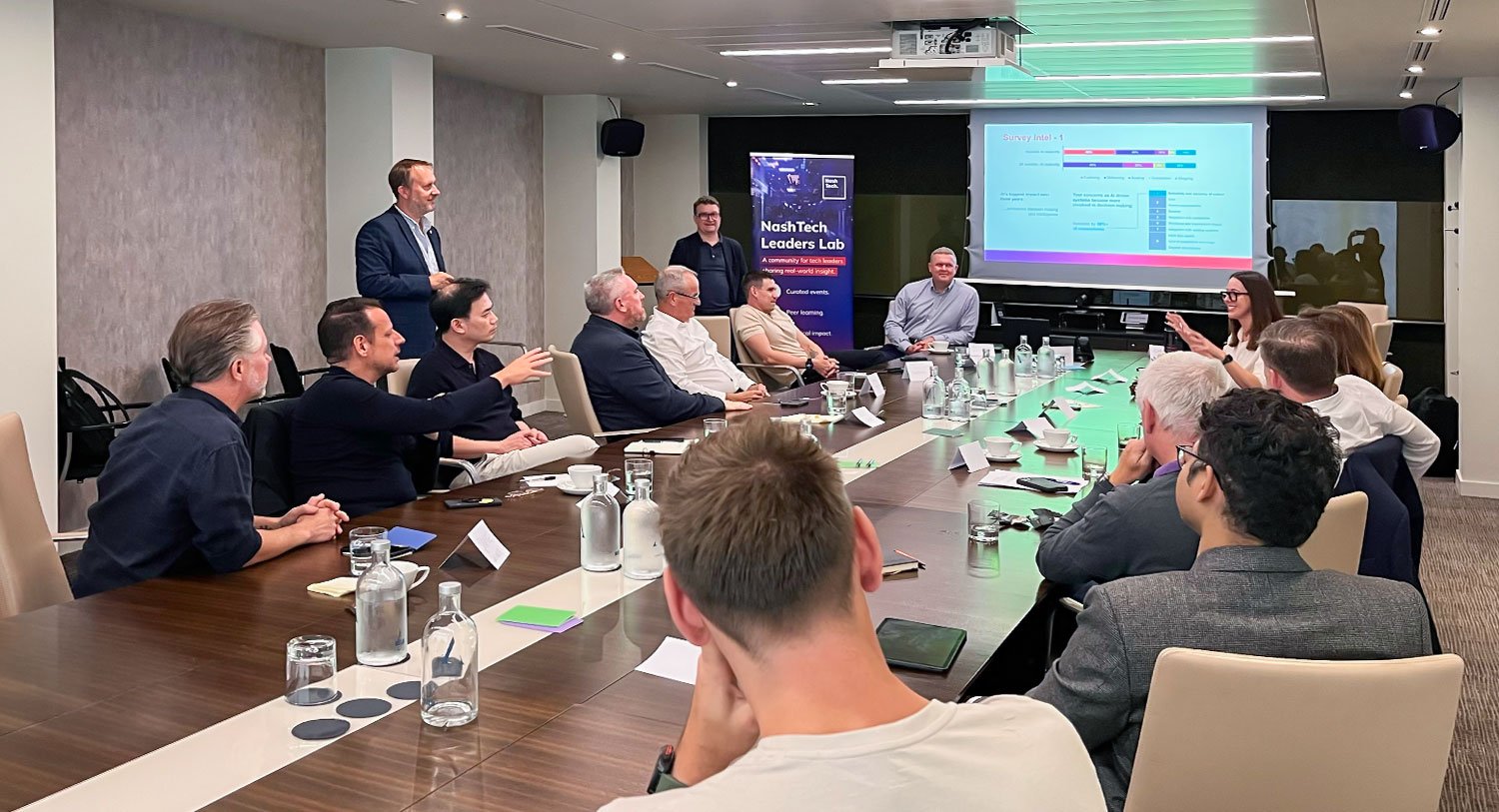
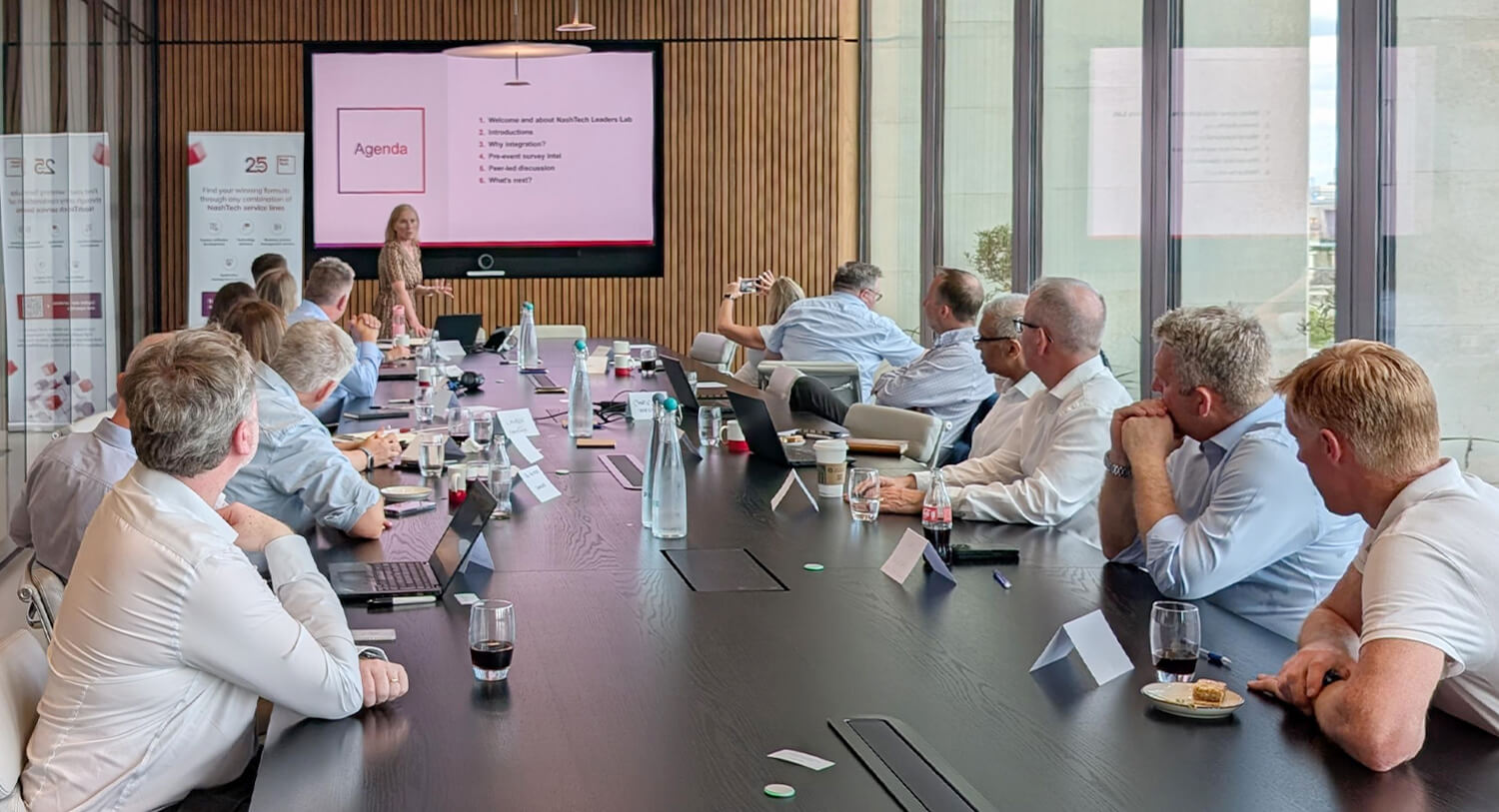
Integration used to be treated as a behind-the-scenes technology task: something for IT teams to solve once the business had decided what it wanted to do. But at NashTech’s latest Leaders Lab event in London, the senior technology leaders in attendance described a very different reality.
Integration used to be treated as a behind-the-scenes technology task: something for IT teams to solve once the business had decided what it wanted to do.
But at NashTech’s latest Leaders Lab event in London, the senior technology leaders in attendance described a very different reality.
Their view was that integration isn’t just about connecting systems. It is about how organisations create value, manage risk, make acquisitions work, prepare for AI and bring people with them through change. In other words, integration is integral to most leadership challenges.
That tension reflects NashTech’s latest global research, Differentiating through custom software, which found that integration is both a major reason for investing in custom software and one of the biggest barriers to delivery.
Let’s dive into the key themes of the Leaders Lab discussion.
Integration cannot be an afterthought
A recurring theme throughout the discussion was that integration is often considered too late in the game.
It becomes visible only when:
- a process breaks,
- data cannot be trusted,
- a customer journey fragments or
- an AI initiative stalls because the foundations were not ready.
This is particularly prevalent in acquisitive businesses, where companies, platforms, processes and data sets are brought together at pace once one business acquires another.
Andrew McManus, Head of Technology at Bridgepoint, described integration as an organisational and political challenge as much as a technical one.
“In any acquisition, integration mustn't be an afterthought or be slowed by disagreements between teams over the right approach.”
Eoin O’Connell, IT Director at The Pembroke Club, reinforced this view, stating:
“All integrations require time, effort, and financial investment. Particularly when it comes to PE-backed companies, the approach to the integration (fully integrated vs hybrid integration) shall be influenced by the value creation / ROI. If the PE plan is to exit in a couple of years, then the integration may be hybrid / bolt-on. Whereas if it’s a longer-term investment, a complete integration may be the best decision, moving the company to be integrated into the IT target operating model for the parent company if there are synergies to be achieved. Also, whether the integration is strategic, tactical or operational will have a bearing on the approach to take.”
Integration must be considered early and intentionally, but the case for doing so depends on proving where it will create measurable business value.
The business case depends on value, not just cost
Integration is often hardest to justify when the work is foundational. Its value may show up later through reduced operational risk, lower support costs, fewer compliance issues or stronger readiness for future change, rather than as an immediate revenue uplift.
The group discussed how that challenge becomes trickier in acquisition-led or private equity-backed businesses, where short time horizons and incentive structures influence what gets funded.
Tim Valmas, Chief Technology Officer at Foresight Group, suggested:
“If the full cost of integration were understood earlier, some deals might look very different. Value can be extracted from a transaction while the legacy debt created by that deal is left behind for the organisation to pay back later.”
Andrew McManus made a similar point:
“Every business will have its own timeline. For example, a private equity-backed business may make different choices from one backed by a long-term owner. In that environment, visible value creation to support the owner’s goals may take priority over any integration work.”
Liz Hughes, an Independent CIO Advisor, showed why the business case needs to be framed in measurable value. She described legacy work that was costing one business around £1 million a year through specialist support and data centre costs.
“By evidencing the cost of doing nothing, we could argue for investment that would release money for higher-value activity. In many respects, integration becomes a boardroom sales job: not a technical clean-up exercise, but a way to reduce risk, release cost and create future capacity.”
But, as the group agreed, value does not always mean simply integrating everything.
Dom Mason, Consultant at Silver Stag Digital, argued that the right answer depends on the operating model and the reason for the acquisition:
“Businesses are often acquired because they are distinctive. Forcing them too quickly into a group model can damage the very qualities that made them attractive in the first place.”
John Boville, Senior Advisor at OC&C, added:
“Post-acquisition integration priorities are management performance and finance controls reporting. Other integration requirements remain within the brand because typically that is where the value sits.”
The takeaway message here was that integration should be deliberate. Leaders need to know where integration creates value, releases cost, reduces risk or, on the reverse, could unintentionally destroy what makes a business special.
Knowing where integration does and doesn’t add value requires businesses to know exactly how their systems and data are connected, which, as the team discovered, isn’t always straightforward.
You cannot manage what you have not mapped
The group discussed many personal past experiences where organisations did not fully understand how their systems and data were connected.
Whilst data and systems may appear integrated on the surface, underneath there could well be duplicated processes, fragile workarounds, undocumented dependencies and knowledge held by one or two people.
Chris Weston, Senior Technology Consultant at NashTech, reasoned:
“A proper audit of platforms and data helps take the politics out of integration. If leaders cannot describe how data moves across the organisation, or who owns that knowledge, they are relying on assumptions rather than evidence. Mapping integrations exposes hidden risks, from compliance issues and single points of failure to critical dependencies that could affect contracts or operations.”
That is why integration debt is rarely just technical debt. It is operational risk, compliance risk, commercial risk and change risk.
Tim Valmas pointed out that this debt can remain inside a business for years, long after an acquisition or project has been forgotten.
“Once the original sponsors have moved on, it becomes harder to build the case for the deeper technology work that still needs to happen, particularly if there is no strong group structure to own it.”
Mapping makes integration visible, but turning that visibility into the right decisions requires clear ownership across both business and technology teams.
Integration decisions need shared ownership
If integration affects data, finance, reporting, risk, operations, customer experience and future growth, who should make the decisions? The group agreed it cannot sit with technology alone. Business units understand operational needs, technology leaders understand what is possible and sustainable, and enterprise leaders need to make sure decisions do not become fragmented by design.
Andrew McManus suggested:
“Integration should be led by business need and value, with technology enabling any change.”
Tim Valmas described the balance organisations need to strike between enterprise consistency and business unit autonomy:
“We should look at what should be standardised horizontally, and what can remain flexible locally.”
Mandie Beitner, Founder Director and Consultant at SorTTed, suggested:
“There should be a neutral business transformation lead or enterprise-level owner who can help look across functions and business units.”
The practical answer is a shared ownership: business-led, technology-enabled and governed at the enterprise level. But this involves having stakeholder buy-in and ownership, which can be challenging if the business believes integration to be a ‘technology issue’.
The biggest integration challenge is often people, not platforms
Many of the discussion points came back to the same conclusion: technology is rarely the hardest part of integration.
The harder work is aligning people around what needs to change, why it matters and how success will be judged.
Eoin O’Connell put it simply:
“Integration has to be sold as a benefit, not imposed as a punishment.”
Azhar Sadique, a CIO advisor, CEO at Aittorney and Council Member of the Chartered Institute of Trade Mark Attorneys, added:
“Integration needs speed, but not at the expense of listening. If change does not feel relevant or workable, people will disengage.”
Kap Monet, Head of Portfolio, Product and Change at Infinigate, highlighted another common risk: assuming approval means alignment.
“A programme may be signed off, but different regions, functions or stakeholders can still have different expectations of success. Integration programmes need more than sponsorship. They need shared understanding, explicit assumptions and a clear definition of mutual success.”
Chris Weston concluded the point by adding:
“Modernisation needs a stronger business narrative. If the business sees only cost and disruption, leaders need to connect the work to something stakeholders care about, whether risk reduction, AI opportunity or growth.”
As organisations turn their attention to AI, the alignment of people, process and ownership becomes even more critical.
AI is exposing the integration problem, not solving it
AI appeared throughout the discussion because it is making integration weaknesses harder to ignore.
Organisations want to move quickly, but AI depends on accessible, trusted and well-governed data.
If systems are fragmented or data flows are brittle, AI can amplify existing problems rather than solve them.
Tim Valmas highlighted that the desire for AI is helping to shine a spotlight on why foundational integration work matters:
“AI can be the latest way to package long-overdue integration work in a future-focused way, as a catalyst for targeted, valuable and well-governed integration.”
Andrew McManus, added
“Without putting the basics in place, organisations may create security gaps or miss the opportunity to adopt new technologies properly to deliver material benefits.”
The leadership question: what should integration enable?
Organisations that are doing integration well are making clearer choices about what should be integrated, what should remain distinct, who owns the decision and how success will be measured.
That means asking difficult questions earlier:
- What should be integrated?
- What should be left alone?
- Who owns the decision?
- What value will integration create?
- What risk does inaction create?
- How will success be measured across different stakeholder groups?
As AI adoption, acquisitions and modernisation programmes accelerate, the difference between strategic and tactical integration will become increasingly visible. The question for leaders is whether they are prepared to treat integration as a strategic capability and give it the attention, ownership and investment it deserves.
But this is tough. Especially when the pace of change is so fast. Azhar Sadique concluded with a comment that resonated around the room:
“Organisations are no longer making one or two integration decisions at a time. They are dealing with legacy systems, new technologies, new industries and changing market demands all at once. Together, these points show why integration needs to be discussed before decisions are locked in. It shapes whether transformation can scale, whether acquisitions create value and whether organisations can respond to change without creating more complexity.”
Ready to make integration a strategic advantage? Explore how NashTech helps organisations connect systems, data and people through smarter software integration, learn more.
If you're a technology leader, join the NashTech Leaders Lab community!