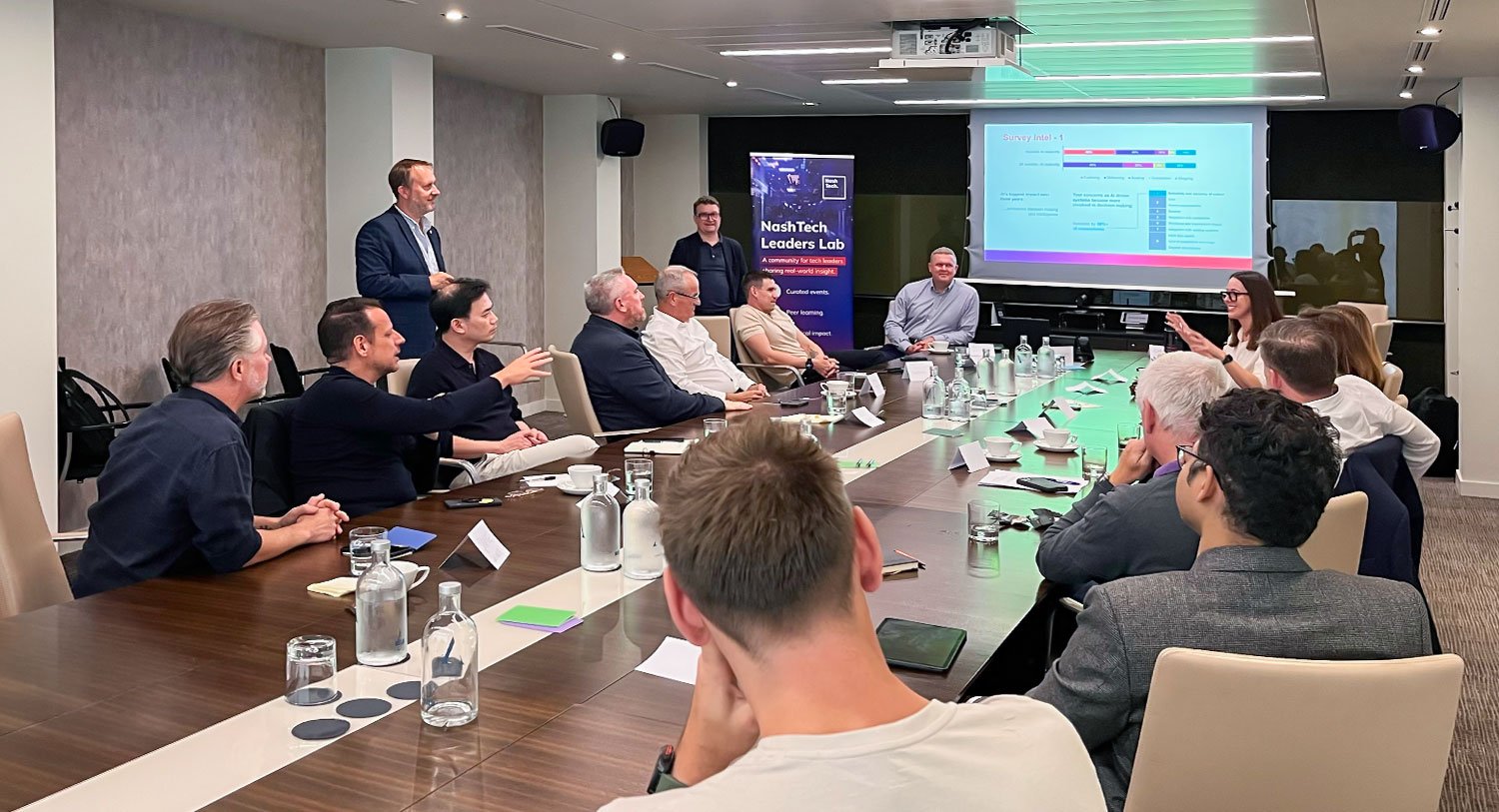
In an interview with CTO Magazine, NashTech CEO John O’Brien explores what becoming AI-native means in practice, and why sustainable transformation requires more than adopting the latest technology.
Artificial intelligence is moving rapidly from experimentation into enterprise execution. But as organisations try to progress from pilots to production, a harder question is emerging: what does it really take to become AI-native?

Speaking to CTO Magazine, John discusses how AI is changing software development, operating models and client expectations. He also explains why architecture, data, integration, governance and organisational culture must evolve together if businesses are to use AI responsibly and at scale.
Here, we share just some of the key questions and insights from the conversation.
What does becoming AI-native mean for NashTech?
For NashTech, becoming AI-native involves transformation across three connected areas.
The first is software delivery. NashTech is increasingly using AI agents throughout the software development lifecycle, supported by orchestration, governance and human oversight. The aim is to automate parts of delivery securely while maintaining the quality clients expect.
The second area is helping clients apply AI within their own organisations, from modernising legacy technology and reimagining products to introducing generative AI into business processes.
The third is using AI within NashTech’s internal operations. Together, these changes represent a significant shift in how the company operates, delivers value and works with clients.
Where does governance fit?
Governance cannot be treated as an additional compliance exercise once an AI system has already been developed.
NashTech builds governance into AI-enabled delivery from the beginning. Although AI can automate significant parts of the software lifecycle, skilled people remain responsible for its outputs and provide oversight at important stages.
“We will always have humans in the loop.”
The objective is not to create a completely autonomous black box. It is to combine automation with human accountability, allowing organisations to benefit from AI without losing visibility or control.
How can an organisation tell whether it is ready to scale AI?
AI cannot compensate for weak business or technology foundations. It can magnify the problems that already exist.
“AI will simply make existing issues worse.”
Before progressing from experimentation to scale, organisations need to assess their architecture, data, integration, security controls and skills.
Business readiness matters just as much. Leaders must understand how AI will affect processes, roles, governance and measures of success. The question is not simply whether the technology can be built, but whether the organisation can support it effectively in production.
John gives the example of a specialist bank that wanted to automate its commercial lending process. Rather than immediately introducing AI, the business first considered the wider operating model, including its processes, integrations, data flows, employee roles, governance and KPIs. By establishing those foundations first, it was able to pursue a more meaningful transformation.
Is moving quickly always an advantage?
AI makes it faster and less expensive to experiment and add functionality. However, that can encourage teams to expand a solution without establishing whether every feature contributes to the intended outcome.
The result can be feature creep, unnecessary complexity and technical debt.
Speed creates value when it is directed towards a clearly defined goal. Leaders should remain focused on the business case, expected return and capabilities required to achieve the outcome – rather than adding features simply because the technology makes them possible.
Taking longer to establish good data, governance, security and observability at the beginning can help an organisation move faster and more confidently later.
How important are people and culture?
Becoming AI-native is as much a cultural change as a technology change.
AI affects established roles, engineering practices, decision-making and relationships with technology partners. It may also create new responsibilities around prompt and context engineering, governance and model oversight.
Leadership must provide clarity about where AI should be used, what remains subject to human judgement and who is accountable for the result.
A strong engineering culture also helps prevent teams from bypassing architecture or creating short-term workarounds. Documentation, reuse, governance and change management may receive less attention than the AI application itself, but they are essential to making it sustainable.
What principles remain constant as technology changes?
John’s career has spanned several major technology shifts, from mainframe and on-premises environments to cloud and now AI. While the technology continues to change, the fundamental business questions remain consistent.
What outcome is the organisation trying to achieve? How will the investment increase revenue, control costs, improve operations or reduce risk? What needs to change across the organisation for those benefits to be realised?
Technology transformations can struggle when implementation moves faster than organisational readiness or loses sight of the original business rationale. For AI initiatives, the intended outcome should provide a consistent thread from the initial business case through architecture, delivery, adoption and measurement.
Will AI make enterprise integration easier?
John expects integration challenges to become more significant as organisations embed AI into their operations.
“Integration challenges will increase, not decrease.”
AI systems depend heavily on the quality, accessibility and provenance of enterprise data. As organisations connect AI to more applications, processes and information sources, weaknesses in the underlying architecture become more visible and consequential.
Integration therefore needs to be addressed strategically. It determines whether AI can access the right information securely, apply it in the correct context and produce results the organisation can trust.
Building an organisation capable of scaling AI
The businesses most likely to benefit from AI will not necessarily be those that introduce it fastest or use it in the greatest number of places.
Lasting advantage will come from combining ambition with strong foundations, human accountability, organisational readiness and a continued focus on measurable business value.
Becoming AI-native is ultimately about building the capability to apply AI securely, responsibly and consistently – turning isolated experiments into sustainable business value.