Summary
AI has moved beyond experimentation, but turning ambition into genuine business value is proving much harder than switching on a new tool.
AI has moved beyond experimentation, but turning ambition into genuine business value is proving much harder than switching on a new tool.
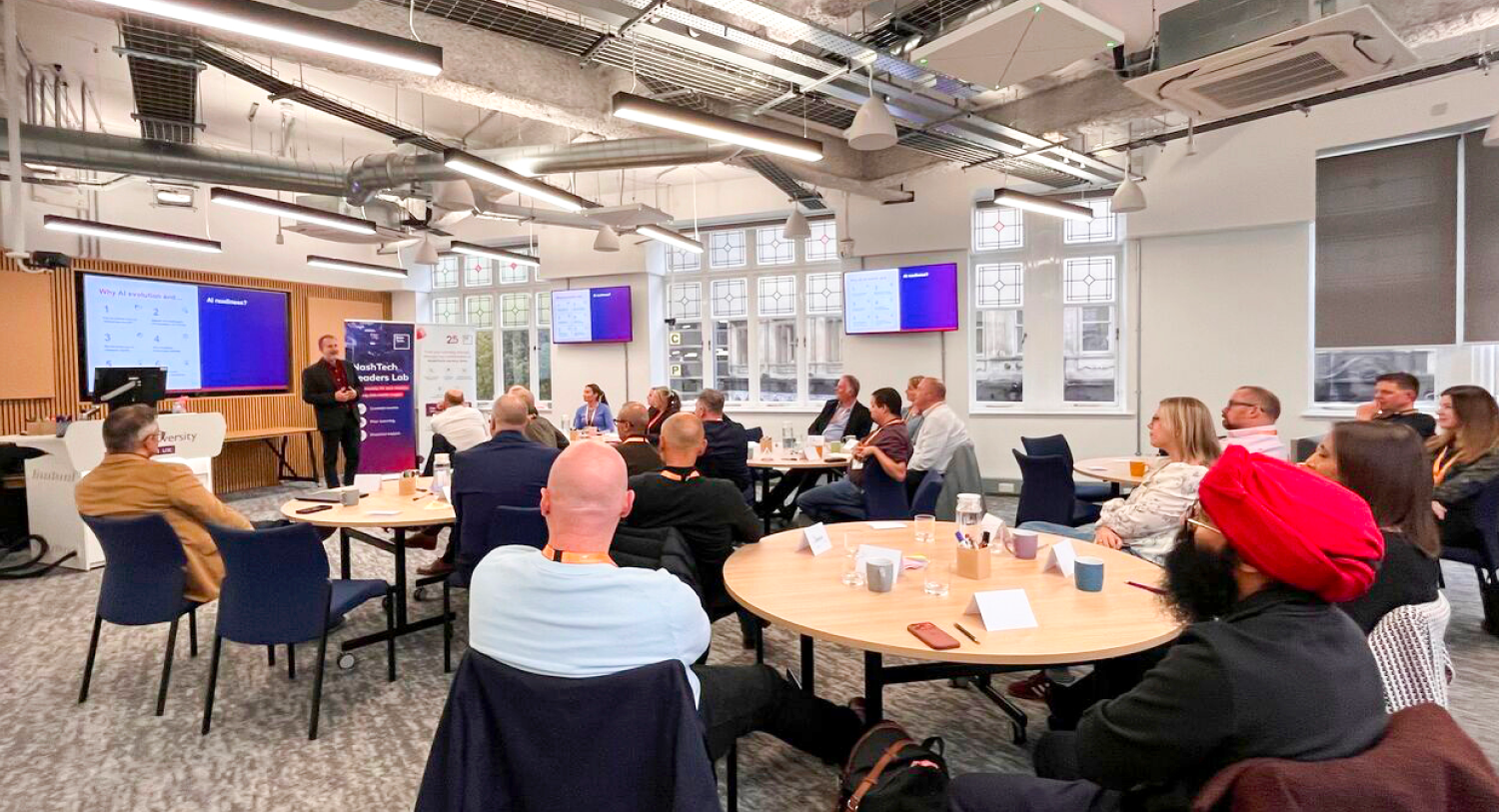
That tension shaped the discussion at NashTech’s latest Leaders Lab in Birmingham in early October, where CTOs and senior technology leaders came together to compare how their organisations are approaching AI, from governance and board expectations to customer experience, operational efficiency and the changing economics of software development.
As with Leaders Lab London, the conversation showed that the question for technology leaders is increasingly not whether their organisation should use AI, but where AI can create meaningful value, what foundations need to be in place and how leaders can move quickly without giving up control.
Before the event, attendees were asked to assess their organisation’s AI maturity. The Birmingham results revealed a market still finding its feet:
- 44% described their organisation as exploring AI.
- 31% said they were delivering AI.
- 17% said AI was embedded across the business.
- 4% believed AI was already shaping their organisation or industry.
Looking 24 months ahead, nobody expected to remain at the exploring stage. Operational efficiency and automation were expected to have the greatest impact over the next three years, while enterprise decision-making ranked lowest, a marked contrast with London Leaders Lab, where it ranked highest.
Security and human accountability were the leading concerns, each selected by more than half of respondents. Meanwhile, the biggest barriers to using generative AI effectively were governance, risk and compliance at 26%, data quality and accessibility at 22%, and skills and capability gaps at 17%.
NashTech’s Senior Technology Consultant, Chris Weston, reflected;
“AI is increasingly exposing problems that were already there: inconsistent data, weak integration, poorly designed processes and unclear accountability. Moving from experimentation to safe value therefore means addressing those foundations rather than layering AI on top of them.”
Different sectors, different definitions of AI value
One of the most interesting differences between Birmingham and London was what leaders expected AI to deliver.
While decision-making and intelligence had been the leading opportunity in London, Birmingham placed greater emphasis on operational efficiency and automation.
Lauren Dally, CTO at Everywhen, argued that this should not be interpreted as a difference in ambition;
“I do not think the difference is a lack of ambition. The Midlands group includes more manufacturing organisations, so the priorities naturally lean towards operations and automation. In financial services, decision-making remains a prominent area for AI investment.”
That distinction matters for CIOs and CTOs. There is no universal AI roadmap. A manufacturer's highest-value opportunity may sit in production or supply chain optimisation, while a financial services organisation may prioritise decision support, knowledge, customer interactions or risk.
Lauren Dally also pointed to another source of pressure: investors.
“In private equity-backed organisations, investors are increasingly asking how AI will increase equity value, not simply how it will improve internal productivity.”
For technology leaders, that changes the conversation. Improving productivity may be valuable, but the more strategic question is increasingly whether AI can influence revenue, proposition, customer experience or enterprise value.
Key takeaway: AI strategy should start with the economics and priorities of the organisation, not with a generic list of use cases. CIOs need to be able to explain where AI creates distinctive value for their business.
Start with the business problem, not AI
Jamie Simcox, Group IT Director at Alexander Dennis, described the challenge of applying AI to a complex manufacturing and supply chain environment.
“There is an unhelpful gap between trivial uses, such as drafting an email, and the expectation that AI will transform the whole supply chain. Finding credible opportunities in that middle ground is the challenge.”
Rather than attempting to solve one enormous supply chain problem with AI, Alexander Dennis is breaking it into smaller pain points and testing individual use cases, some of which are already proving successful.
James Longmore, Director of Digital Services at Aston University, made a similar argument from a very different sector.
“Aston is developing several agents, including a tutor designed to help students learn programming using university material. But the objective is not to replace lecturers. It is to remove repetitive elements of teaching so academics can spend more time adding value.
The question should be how technology can help during that first month, not ‘Where can we use AI?’ We need business problems from the organisation, not vague requests to add AI to something.”
The example is telling. Some first-year and international students struggle with the transition into university life. Providing them with the right information at the right moment could help students settle in and reduce the risk of becoming disconnected during those critical first weeks.
The lesson extends well beyond education: good AI programmes begin with friction, outcomes and users. Not technology.
Look for value beyond headcount reduction
Boards naturally want proof of ROI. But several leaders questioned whether the AI business case has become too closely associated with automation and cost reduction.
Richard Veys, IT and Transformation Director at UK Flooring Direct, put it bluntly:
“Our AI business cases tend to rely on one of three things: evidence, fear of missing out or faith. Very few reach the evidence threshold.”
He argued that AI's larger opportunity can be seen as a multiplier, improving quality, accelerating speed to market and helping businesses reach customers more effectively.
UK Flooring Direct offers a practical example. The company has traditionally relied heavily on Google pay-per-click advertising, but the way customers find products is changing. Instead of searching for a technical product name, a customer might ask an AI assistant: “What flooring will work in my bathroom?”
The business is therefore turning product and supporting information into machine-readable content that can surface through AI search. AI is also helping transform relatively bland supplier information into useful descriptions and imagery.
Veys continued:
“A process that once took months can now take hours. For us, the advantage is speed to market and visibility with customers, rather than simply removing a back-office task.”
Key takeaway: Coding may become faster, but coding is only one part of software delivery. Organisations still must understand the problem, define the outcome, test the result and govern what ultimately reaches production. Challenge AI business cases built solely around removing cost. Look equally closely at revenue, customer experience, quality, capacity and speed to market.
AI could change the economics of build versus buy
AI-assisted development is also prompting some technology leaders to revisit a question that has existed for decades: should we build or buy?
Chris Price, Managing Director at Advoco Innovart, argued that the fundamental principle has not changed:
“Build versus buy has always depended on where competitive advantage sits. Organisations would not normally rebuild a finance or HR system, but they might build customer-facing capabilities that strengthen the value proposition.”
What AI may change is the economics.
Peter Wainwright, Head of IT at Baxi, explained:
"When I look at the licence costs for SAAS platforms that are supporting non-differentiating process, such as Health and Safety Management, and I'm wondering whether it's now more cost effective to vibe code a bespoke App using AI than keep paying the subscription fees."
Modern cloud platforms, APIs, DevOps and continuous delivery have already reduced some of the historic risk associated with custom development. AI could push that equation further. Systems of record may remain obvious candidates for buying, while capabilities that distinguish the business become stronger candidates for building
That does not mean organisations should start building everything. Instead, CIOs may need to periodically revisit assumptions made when software development was slower and more expensive.
AI can expose the problems organisations have learned to tolerate
The promise of agentic AI often centres on greater autonomy. But giving technology more autonomy also magnifies weaknesses in the processes and data underneath it.
Chris Weston highlighted that poorly used ERP fields, placeholder dates or inconsistent data might survive in an existing manual workflow. Once an automated system begins acting on that information, those weaknesses become far more consequential.
John Reid, Director of Software at SoloProtect, argued that organisations therefore need to understand the complete journey:
“Teams need to map the current journey: every touchpoint, who can access or change the data, where it can break, and what controls prevent an automated failure.”
And many of those issues are not actually AI issues at all.
“Some of that is data quality, but much of it is access, permissions, business rules and process design. Those controls matter even when AI is not involved.”
That is perhaps one of the clearest messages for CIOs considering agentic AI. Greater autonomy increases the importance of boring fundamentals rather than removing them.
As Chris Weston put it, accountability also does not disappear when a human is removed from a process.
Give people freedom to experiment, but know when experimentation becomes infrastructure
Peter Truman, Software Development Manager at Weatherbys Private Bank, described how the organisation is trying to encourage experimentation while preventing uncontrolled access to data.
“Citizen developers and new tools can assist in eliminating manual processes, but tools such as Power BI also create challenges in data control and export, providing both controls at some levels but potential loopholes at other levels. The aim is to monitor and maintain data security controls without stopping the business from improving.”
There is also a practical issue around access. One employee can create something genuinely valuable using Copilot, while someone elsewhere in the organisation cannot use the same solution because they lack the licence or access to the underlying information. Eventually, some successful citizen-developed tools need to cross a boundary and become corporate-grade, supported capabilities.
Truman gave a simple personal example. His morning AI prompt looks across recent email, his calendar, recurring commitments and previous meeting transcripts to remind him what he has committed to and prepare him for his day ahead.
The use case is small, but it highlights an important route to adoption. Employees often discover valuable applications before a central AI programme does.
Key takeaway: Allow experimentation but define the point at which a personal productivity tool or citizen-developed workflow requires formal ownership, security, testing and support.
Trust is as much about assurance as accuracy
Another strong thread throughout the conversation was trust.
Tony Colson, Director of IT at The British Psychological Society, described how AI is being trialled to support blind assessment for research awards. It removes personally identifiable information and other details that might influence a reviewer before a person checks what has been removed.
The AI does not make the judgement. Instead, it improves the consistency of the process surrounding that judgement.
“The previous process took several weeks and depended heavily on individual judgement. AI has not decided for us; it has made the preparation of material more consistent for the people reviewing it.”
For Heena Mistry, Non-Executive Director at Platform Housing Group, that raised another question: what does a board need before it can feel confident approving an AI initiative?
"Technology teams may believe they have provided enough evidence to proceed with an AI initiative, while board colleagues may not yet share that level of confidence and may need further assurance.”
She pointed to housing as an example. AI could potentially use data to predict issues such as damp and mould before a resident reports them, creating an opportunity for better outcomes. But boards need to understand the risks, safeguards and how the initiative will be governed before deciding whether to proceed.
For CIOs, this suggests that technical confidence and board confidence are not the same thing. Successful AI leaders will need to translate governance, data quality, controls and accountability into a level of assurance that colleagues outside technology can understand.
Protecting intellectual property in an AI-first world
AI is also challenging organisations whose products are their information.
For The British Psychological Society, books, journals and professional knowledge are valuable intellectual property. Yet those assets also need to remain discoverable as users increasingly turn to AI interfaces for information.
Tony Colson described the tension:
“We need our content to be discoverable through tools such as Gemini, but we don’t want those systems to scrape the material that gives our products their value.”
It leads to a much larger strategic question:
“If customers can obtain the value of our products through AI, will they still purchase them from us?”
Retrieval-augmented generation offers one possible route because information can be surfaced through natural-language experiences while retaining references back to an authoritative source. For professional and academic information, that provenance can be critical.
But CIOs will increasingly need to think beyond protecting data moving into an AI system. They also need to consider how AI could fundamentally alter the value and distribution of the organisation's intellectual property.
Don't optimise a customer journey that may be about to disappear
Perhaps the most strategic part of the conversation looked beyond using AI inside today's business processes.
What if AI changes the processes themselves?
Lauren Dally offered a useful example. Businesses can use AI to become better at managing Google leads, but what happens if customers increasingly stop using traditional search in the first place?
“People already have Gemini, ChatGPT and other assistants on their phones. If they begin searching and buying through those interfaces, customer behaviour and the route to market will change fundamentally.”
The challenge for technology leaders is therefore twofold: make today's organisation better while considering which parts of today's organisation may not exist tomorrow.
As Lauren Dally put it:
“We need to solve today’s problems without forcing AI into every gap we can find. At the same time, we have to recognise that in service industries the way customers consume products may change in months rather than years.”
That is a very different strategic question from “Where can we deploy Copilot?”
AI expectations need to become more specific
Finally, several leaders returned to the gap between enthusiasm at executive level and the ability to define what success actually looks like.
Gary Allwood, IT Director at ABP UK, observed that people closer to the work can sometimes articulate those outcomes more clearly:
“In my organisation, younger colleagues often articulate what they want from AI more clearly than senior leaders because they are closer to the task and can describe the practical outcome.”
James Longmore cautioned against assuming this is purely generational, however. Confidence and willingness to engage with AI vary across age groups.
The more important divide may therefore be between people who understand the task closely enough to define a useful outcome and those approaching AI as an abstract strategic objective.
From AI ambition to execution
If there was one message running through the Birmingham Leaders Lab, it was that AI ambition is running ahead of execution.
The opportunity is not in doubt. Around the table, leaders described applications spanning student support, software development, retail discovery, manufacturing, operational technology, knowledge management, governance and personal productivity.
But enthusiasm alone does not create value.
Technology leaders still need to solve familiar problems around data, integration, security, skills, process design and governance. They need to decide where custom technology creates differentiation and where buying remains sensible. They need to give employees room to experiment without creating tomorrow's shadow IT problem. And, increasingly, they need to help boards translate AI enthusiasm into specific business outcomes.
As Chris Price neatly summarised:
“The visible part of the iceberg may be easy; the 80% or 90% underneath has always been the challenge. AI may be the same old problem, only faster.”
For CIOs and CTOs, perhaps that is the real challenge of the next phase of AI.
It is no longer about proving that the technology can do something impressive. It is about deciding what is worth doing, what must be true for it to work at scale, and how to make sure the organisation is ready for whatever comes next.
As Chris Weston concluded, the immediate priority is to close the gap between AI ambition and execution, strengthen the conversation with the board, and test whether today's pilots genuinely have the foundations required to move safely into production.
Want to join the next conversation?

Leaders Lab brings senior technology and tech-centric business leaders together for candid, practical conversations, small-group events and peer-created resources.
Visit the Leaders Lab hub and request to join the community to receive updates and invitations to future sessions.