Summary
For something that underpins almost every digital initiative, integration rarely gets the attention it deserves. Boards approve AI programmes. CIOs invest in cloud platforms. Business leaders champion transformation. Yet behind many of these initiatives sits the same persistent challenge: systems that struggle to communicate, data that cannot be trusted and architectures that have evolved faster than anyone intended.
For something that underpins almost every digital initiative, integration rarely gets the attention it deserves.
Boards approve AI programmes. CIOs invest in cloud platforms. Business leaders champion transformation. Yet behind many of these initiatives sits the same persistent challenge: systems that struggle to communicate, data that cannot be trusted and architectures that have evolved faster than anyone intended.
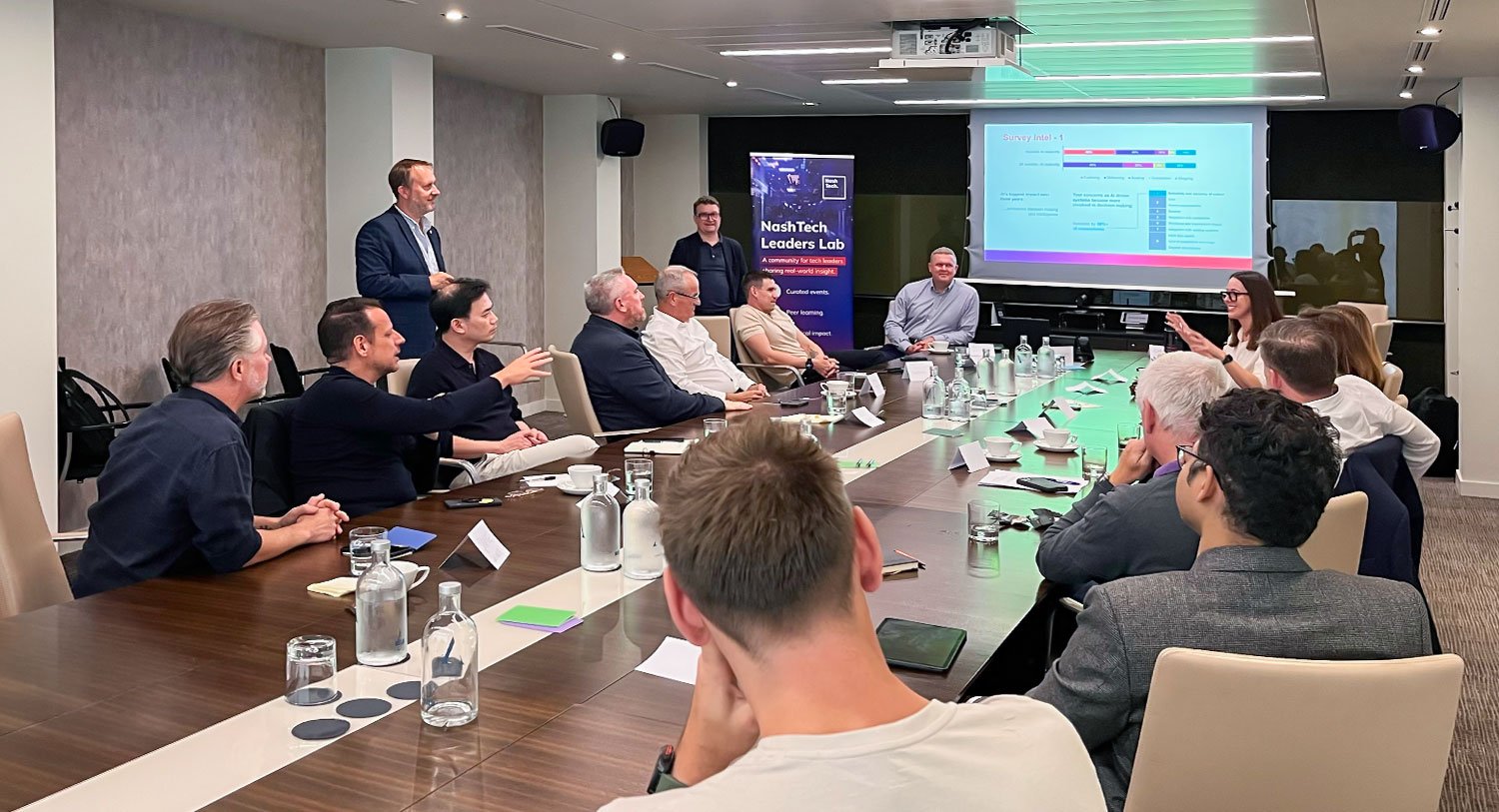
At the third NashTech Leaders Lab event, this time in Leeds, technology leaders from sectors including financial services, logistics, higher education, media and telecommunications explored why integration needs more attention than ever.
Let’s dive into it.
Integration is… a business-wide issue
Over time, acquisitions, departmental tool choices, legacy systems and rapid growth can make an organisation’s technology estate more complex. The way that estate is connected often reflects how the business itself operates, makes decisions and delivers change.
Leaders Lab members recognised this as a change in the conversation, one that positions integration as an enabler of business strategy, not simply an engineering exercise.
It encourages leaders to ask, “What are we trying to achieve as a business and how does integration help us get there?”
As George Lynch, Global Advisory Director at NashTech observed:
"Technologists should stop talking about “the business” as if it is separate from technology. Technology and business priorities are deeply connected, and integration needs to be framed as part of the organisation’s operating model rather than as a detached technical concern. In the same way that technical debt is really business debt, integration reflects how organisations are structured. Rather than asking, ‘how do we connect these systems?’, organisations should first ask ‘what business outcome are we trying to achieve?’"
Hina Jain, Principal at Alysian, reinforced this idea, explaining that organisations often try to solve technology problems before defining the business value.
"Start from the business value and what outcome the business is trying to achieve rather than allowing technology choices to drive the business direction.”
Integration is… a gateway to using AI effectively
Most organisations want to use AI, and they want to use it now.
But AI success depends on the foundations of good, accessible, well-understood data, which few organisations admit to having.
If data is trapped in different systems, duplicated, poorly owned or unreliable, AI will not fix that. Instead, AI will expose those problems faster.
Integration, therefore, is one of the very factors that determines whether AI succeeds.
George Lynch summarised it perfectly:
"AI will only expose poor-quality or missing data faster. Every business needs to understand what data it actually holds, where it comes from and whether it is fit for purpose, whether it is simply moving data, enabling operational change, or supporting the successful implementation of SaaS and ISV products.”
Taya Reynolds, Board Member and former CIO at Hays Travel, agreed, highlighting that customer expectations are now driving organisations to understand and connect data across every touchpoint.
"Customers now expect real-time, accessible and joined-up digital experiences, which require organisations to understand and manage data across multiple touchpoints. Without that foundation, organisations cannot create better customer journeys or apply AI effectively.”
Because AI is already high on the board agenda, positioning integration as foundational AI work can also help business leaders understand its value and get behind the investment.
Integration is… largely invisible
The irony of integration is that nobody notices it until it breaks.
The group discussed how to justify investing in something that many barely even notice. Unlike a new customer portal or AI assistant, successful integration rarely has obvious visibility. Its value comes from everything working seamlessly behind the scenes.
The key is to make the invisible visible.
Rather than presenting integration as a technical cost, leaders need to connect it to business outcomes such as customer retention, speed to market, lower risk, reduced run costs, better reporting and stronger decision-making.
Natalie Whittlesey, Technology Community Director at NashTech, captured the challenge:
“Integration can be difficult to justify to boards because, like security, its value is often invisible when it works well. The challenge is explaining the ROI in business language and showing what integration enables, rather than positioning it as a technical cost.”
Simply put, Boards don't buy integration.
They buy faster customer onboarding, better reporting, improved decision-making and more resilient operations.
The challenge for technology leaders is to connect integration investment directly to those outcomes rather than presenting it as another infrastructure cost.
Because the real return on investment isn't integration itself.
It's everything integration makes possible.
Integration is… contextual
One of the strongest themes throughout the discussion was that integration looks very different depending on the organisation.
- In financial services, regulation forces high standards of governance.
- In publishing, speed often matters more than perfection.
- In healthcare, accuracy and provenance become non-negotiable.
Jon Saunders, Group Director of Core & AI at Reach Plc said:
"Different industries require different levels of data quality depending on their risk profile. In fast-moving media environments, some reduction in data quality may be acceptable to support speed and experimentation. However, in healthcare, for example, the tolerance for uncertainty is much lower because confidence in provenance, accuracy and change history is essential.”
Basem El-Haddadeh, who has led technology transformation at De Montfort University, Leeds Beckett University and other universities explained:
“Higher education has historically had less pressure to integrate and analyse data because universities mainly needed to report back to government for funding. That is changing as competition and economic pressures increase. Universities are beginning to recognise that better data management, mining and consolidation can help them make better commercial decisions.”
Garvit Rastogi, Product Owner at Worldline, agreed:
“Regulation, risk appetite and comfort with existing systems all shape how organisations approach integration. In highly regulated environments, fear of disruption can prevent modernisation even when the current systems are inefficient.”
The core point is you cannot design integration in isolation. You need to understand the business context first: what level of data quality is required, how much risk the organisation can tolerate and what decisions the data will support.
Integration is… often centred around what you cannot replace
Not every organisation has the luxury of starting again. Cost, operational risk, internal politics and business continuity often make full replacement unrealistic.
Many continue to rely on platforms that remain business critical despite their age.
Mazella Heaton, Transformation and Delivery Director at Kuro Health shared how her organisation deliberately invested in integration rather than replacing legacy systems outright:
“We used integration as a way to strengthen the business model when the board had no appetite to replace legacy platforms, using it to increase customer stickiness and reduce competitive risk.”
Instead of ripping everything out, they connected customers and suppliers to existing platforms, introduced an integration layer and gradually extracted business processes over time.
Sometimes the smartest transformation isn't replacing legacy. It's making legacy work harder.
As George Lynch reflected afterwards:
"Integration should not be pitched as a problem to be solved, but as a strategic capability that enables a specific business model."
In this context, integration can extend the value of legacy platforms, reduce dependency on ageing systems and create room for gradual modernisation without disrupting critical operations.
Phillip Liu Director of Data and AI at Quickline Communications, made an interesting point:
“Legacy modernisation is often political and cost-driven: leaders may recognise the need to replace old systems, but choose to keep paying for expensive legacy expertise because it is cheaper in the short term than funding a major transformation programme.”
Integration gives organisations a way to modernise around legacy systems, rather than waiting until they can replace them.
Integration is… hiding in plain sight
Perhaps the most revealing discussion centred around trust
Many organisations say they have poor-quality data.
But is the data really poor?
Or do people simply no longer trust it?
Phillip Liu captured this political reality perfectly.
"Operational teams often say, 'I can't trust the data.'"
But Jenny Daker, Engagement Manager at NashTech, pointed out that the same piece of data can exist in different places, with different teams using different versions as the source of truth. This creates confusion, inconsistency and competing interpretations of what is accurate. Her point reinforced the link between integration and data quality: once an organisation has more than one system, data synchronisation and ownership become central challenges.
"You could have the same piece of data stored in different places and everybody is using different versions as their source of truth."
The integration problem often isn't obvious.
When people say they cannot trust the data, the root cause may be an integration issue hiding behind inconsistent reports, duplicate records and manual workarounds.
These aren't isolated issues.
They're symptoms of disconnected organisations.
Integration is… integral to transformation, and shouldn’t be patched on afterwards
Transformation programmes frequently focus on implementing the exciting new platform.
Integration becomes tomorrow's problem.
Taya Reynolds challenged this mindset.
"Integration problems are less about the technology itself and more about strategic priorities and enterprise thinking. When boards are excited about a new product or acquisition, they often want implementation to happen quickly, while integration is treated as a secondary concern. When actually, integration should be baked into implementation from the start, even if it takes longer.”
By the time organisations return to it, costs have risen, technical debt has grown and opportunities have already been lost.
George Lynch said:
“Founder-led and private-equity-backed businesses often prioritise speed to market in their early stages, rather than designing integration intentionally from the start. That is understandable because the priority is to validate and sell the idea, but after several years the resulting architecture can become a constraint. At that point, organisations need help untangling the integration and data problems that were created during rapid growth.”
Successful transformation treats integration as part of the solution from day one, not an enhancement for phase two.
Jonathan Vardon CIO & Advisor at River AI and Vardon Consulting, said
“In many organisations you see costly point-to-point integrations create unnecessary complexity. Introducing an integration layer can be a ‘no regrets’ investment because it simplifies the landscape, decouples systems and allows organisations to address different parts of the estate at their own pace.”
Basem El-Haddadeh observed:
“Integration is often considered too late in the product lifecycle. By the time organisations recognise the need for integration, it has become expensive and difficult to justify. Procurement processes are starting to improve, with integration increasingly being treated as a minimum requirement for new systems. However, suppliers may still say “yes” during procurement without fully understanding how they will deliver the integration later.”
Jonathan Vardon added:
"Organisations need the capability to challenge suppliers constructively and make informed procurement decisions while building value-driven partnerships. Strong supplier relationships are founded on transparency, mutual accountability and shared outcomes. Without that capability, poor decisions increase costs over time and departments may turn to shadow IT when central systems or processes fail to meet their needs. Shadow IT then compounds integration challenges and is often only discovered when something breaks."
Integration should be designed into transformation from the start, because treating it as a later-stage technical task only increases cost, complexity and risk.
Integration is… serious business
Integration affects far more than technology performance.
It influences customer experience.
It generates revenue.
Steve Lovell, Technology and Engineering Director at Reconomy explained how integration has become one of his company's biggest differentiators.
"Our USP is the ability to work with whatever data and formats our customers have."
Rather than forcing customers to adapt, the business adapts to them.
That flexibility wins contracts and creates customer loyalty.
Integration done well, becomes a commercial capability.
Integration is… a board-level conversation
Ultimately, integration succeeds when leadership sees it as a business capability rather than an IT initiative.
The board conversation should begin with where the organisation wants to get to, for example, growth, profitability, working capital, expense ratio, EBITDA or revenue. From there, the organisation should identify the KPIs and operational metrics that need to be true, then work backwards to understand what technology and integration capabilities are required.
This “right-to-left” approach prevents teams from trying to build business cases for isolated technical fixes. Without a clear business driver, integration work is unlikely to receive support.
Jonathan Vardon described the right starting point.
"The board conversation should begin with where the organisation wants to get to."
Hina Jain said:
“Any organisation must first determine which business capabilities and systems need to connect to achieve its strategic objectives, then manage integration strategically at enterprise portfolio level rather than a series of isolated technology projects. This prevents individual teams from creating multiple point-to-point integrations that solve local problems but increase complexity, cost and technical debt over time.
The focus should remain on enterprise business value, not the priorities of individual functions or silos. Technology shall enable that enterprise vision; not define it.
The challenge is that executive stakeholders often have different expectations. Some are primarily interested in the business outcomes and the information they receive, with little need to understand the underlying integration. Others want confidence that there is a coherent enterprise integration strategy supporting long-term scalability, resilience and future change. Successful leaders therefore communicate at both levels: articulating the strategic integration vision while demonstrating the tangible business value it delivers.”
Mazella Heaton shared her account of how to get that all-important board-level interest:
“Our board pitch focused on customer stickiness: by giving customers real-time visibility of their cases and updates from the back office, the business could make itself easier to work with and harder to leave.”
When integration is framed around business value instead of technology, investment conversations become significantly easier.
Conclusion
Start with business outcomes
Integration needs to be framed around business outcomes, not architecture. Investment is easier to justify when it is linked to growth, profitability, working capital, customer retention, operational efficiency, compliance and reporting confidence.
Do not wait until integration becomes a blocker
Integration rarely becomes a headline issue until it prevents the business from doing something urgent, such as launching a product, improving reporting, modernising a legacy platform, delivering a better customer experience or scaling AI. By then, the cost of fixing it is often higher.
Treat integration as an enterprise capability
Integration should be treated as an enterprise capability, not a technical afterthought. Done well, it gives organisations the confidence to move faster, make better decisions and turn strategy into execution. Done badly, it becomes the hidden constraint that slows everything else down.
How NashTech can help
If your organisation is trying to realise value from AI, improve data quality or modernise complex systems, NashTech can help you build an integration strategy that connects technology decisions to business outcomes.
We help organisations simplify complex technology estates, modernise legacy environments and build integration strategies that support long-term business outcomes, not just short-term technical fixes.
Speak to our experts to explore how your integration landscape can become a competitive advantage rather than a hidden constraint.
If you're a technology leader who would like to share thinking, sense-check challenges and learn from peers, join the NashTech Leaders Lab community.